
T Is For Tomatoes


Few ingredients occupy quite so central a place in the kitchen as the tomato. It appears in almost every cuisine touched by the modern world, from the simplest sliced salad to the richest slow cooked sauce, and yet its journey to such ubiquity was far from straightforward. For a fruit now so utterly essential to global cooking, the tomato spent a surprisingly long time being viewed with real suspicion.
The tomato originated in the Andean regions of South America, where wild varieties grew long before cultivation began in earnest in Mexico. It was the Spanish who carried it back to Europe in the sixteenth century, yet for a considerable time it was treated more as a curiosity or even a danger than as food, its close relation to poisonous nightshade plants earning it a reputation for toxicity that lingered for generations. It was Italy, more than anywhere else, that first embraced the tomato wholeheartedly, weaving it into the cooking that would eventually define an entire national cuisine and, in time, convince the rest of Europe of its worth.
A Fruit Of Remarkable Range
Botanically a fruit, though almost universally treated as a vegetable in the kitchen, the tomato offers an extraordinary range of character depending on variety, ripeness and preparation. A firm, barely ripe tomato brings a sharp, almost citrus like acidity, while one left to ripen fully on the vine develops a deep, almost savoury sweetness that needs little more than good olive oil and a pinch of salt to shine. This natural savoury quality, often described as umami, is part of what makes the tomato so fundamental to so much cooking, its ability to add depth and roundness to a dish in a way few other fruits or vegetables can match.
Cooking transforms the tomato further still. Slow cooked, its water content reduces and its sugars concentrate, deepening into the rich, almost caramelised base of a good pasta sauce or braise. Roasted, it takes on a smoky sweetness that raw tomatoes simply cannot offer. Even in its simplest form, sliced and lightly seasoned, a truly ripe tomato at the height of summer remains one of the great, uncomplicated pleasures of the kitchen.
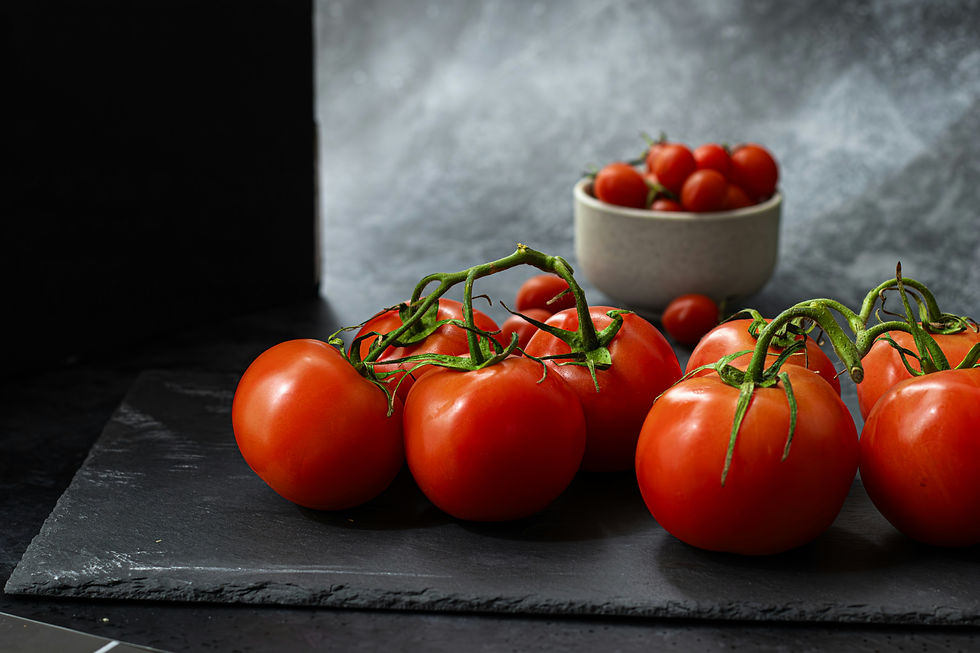
The sheer diversity of varieties available today, from the tiny intensity of cherry tomatoes to the meaty richness of a beef tomato and the delicate sweetness of heirloom varieties in every colour imaginable, has done much to restore the tomato's reputation as a genuinely interesting ingredient, rather than the uniform, often flavourless supermarket staple it became for a time during the twentieth century.
Fun Facts About Tomatoes
The tomato was once believed to be poisonous in parts of Europe and North America, a reputation likely linked to its close relation to deadly nightshade rather than any genuine danger.
In 1893, the United States Supreme Court ruled that the tomato should legally be classified as a vegetable for the purposes of trade tariffs, despite its botanical status as a fruit.
There are thousands of tomato varieties grown around the world, ranging enormously in size, colour and flavour, from tiny currant tomatoes to giant beefsteak varieties weighing well over a kilogram.
Italy did not fully embrace the tomato in its cooking until the eighteenth century, several hundred years after it first arrived from the Americas.

Using Tomatoes In The Kitchen
Slow roast whole or halved with olive oil and garlic until soft and slightly caramelised, then blend into a rich, simple pasta sauce.
Slice ripe tomatoes thickly and serve simply with good olive oil, flaky salt and torn basil for a classic summer salad.
Simmer chopped tomatoes with onion and warming spices as the base for a curry, stew or shakshuka.
Halve cherry tomatoes and roast at a low heat until slightly shrivelled and intensely sweet, ideal for scattering over salads or bruschetta.
The tomato's journey from suspected poison to kitchen essential is a reminder that reputation and reality do not always align. Whether raw, roasted or slow cooked into something rich and deep, it remains one of the most fundamental ingredients in cooking today.
As the old saying goes, know your onions, though in the kitchen it might just as easily be said that a good cook knows their tomatoes, a fruit capable of carrying an entire dish on its own quiet sweetness.


